
1. Start with the crest details that matter most
A good school crest should be easy to recognise from a few metres away, whether it sits on a golf shirt, blazer pocket, cap or sports top. The first step is deciding which parts must stay sharp. Small text, fine lines and tiny border details often look neat on a computer file but can lose readbility once they are stitched or printed onto fabric.
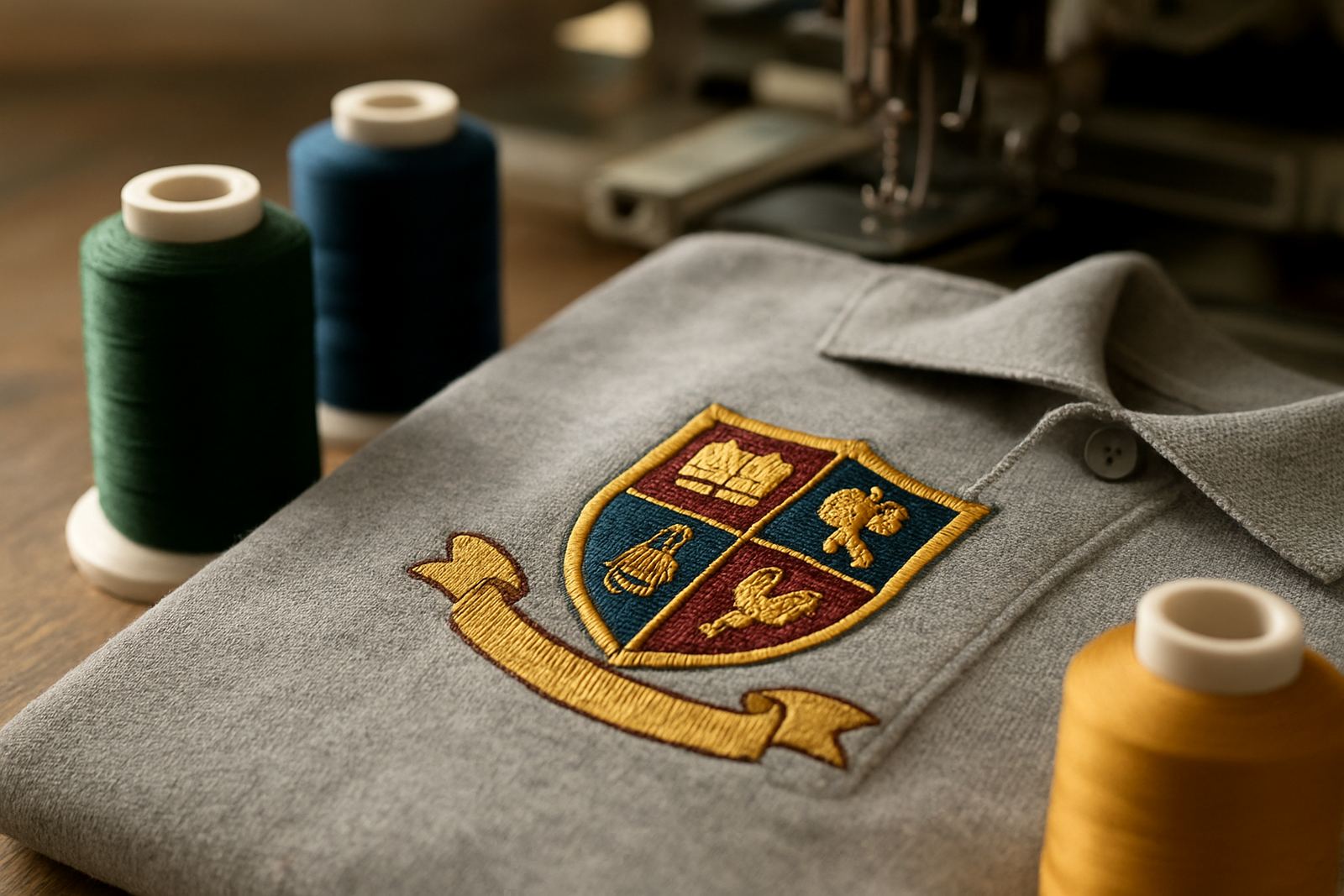
For most school uniforms, keep the most important elements simple: the school name, shield shape, motto if it is short, and one or two strong symbols. Very thin lines, tiny stars and complicated shading can disappear on textured fabric, especially on knitwear and caps. If the crest will be used on several items, plan one clear master version that can be adapted for embroidery, screen printing or heat press work.
- Keep text large enough to read at 5 to 10 metres.
- Avoid very fine outlines on the outer edge of the crest.
- Make sure the main colours still stand out on white, navy and black garments.
- Ask for a sample run before a full bulk order.
2. Match the decoration method to the garment
Not every school item should be decorated the same way. Embroidery gives a raised, hard wearing finish that suits golf shirts, blazers, caps and tracksuits. Screen printing works well for flatter artwork and larger crest placements on cotton or polycotton shirts. Heat press printing is useful for certain sports garments and shorter runs, especially when you need quick turnaround for tours, camps or replacement stock.
In Durban North, schools often need uniforms that handle coastal humidity, afternoon rain and regular washing. That means the base garment matters as much as the decoration method. A good quality shirt with a stable weave will hold embroidery better than a thin, stretchy fabric that pulls out of shape. If the crest is going onto caps, check the cap panel size and seam position so the design does not sit crooked or close to the curve at the side.
- Use embroidery for long lasting visibility on collars, caps and chest placements.
- Use printing when the crest includes broad blocks of colour or larger artwork.
- Choose a method that suits the fabric weight and school use.
- For sportswear, test how the decoration feels against movement and sweat.
3. Keep the stitch count and size under control
With embroidery, more detail is not always better. Too many stitches can make a crest stiff and bulky, especially on lightweight golf shirts or cap fronts. A well planned digitised file balances detail with fabric movement. That is where in-house digitising helps, because the file can be adjusted to suit the item instead of forcing the same setup onto everything.
Size matters just as much. A crest that works on a blazer pocket may be too small for a golf shirt and too large for a cap. It helps to set different size versions for each item. The goal is to keep the school identity consistent while making sure the crest still looks clean at each size. If the design is too compact, thread colours may blend together and the edges can close up after a few washes.
- Ask for separate sizes for shirts, caps and outerwear.
- Keep thin text away from the very edge of the design.
- Use enough negative space so the crest does not fill in.
- Check the final sample under natural light, not only indoors.
4. Choose thread and print colours that hold up well
School colours often look simple on paper but can shift once they are placed on fabric. Navy, maroon, gold and green are common, but they need careful matching so the crest still looks like the school everyone knows. On lighter shirts, some colours stand out nicely. On darker garments, underlay or a border may be needed so the details remain visible.
Thread choice also affects durability. Strong, colourfast threads help the crest stay presentable through frequent washing, tumble drying and daily wear. For printed items, ink and transfer choice should suit the fabric and the expected use. A school that sends garments home every Friday needs a different finish from one that issues new stock once a term. Around coastal areas like La Lucia, Umhlanga and Ballito, this matters even more because damp air can affect how garments are stored between wears.
It is worth comparing colours on the actual garment, not just on a screen. Small changes in shade can make a crest look faded or too busy. A sample on the real fabric gives a more honest result than a rough visual alone.
5. Prepare artwork properly before production starts
Clear artwork saves time and prevents avoidable errors. Schools often send older logos, scanned images or photos of crests taken from old shirts. These are useful starting points, but they usually need cleaning up before production. Straight edges, correct spelling, proper spacing and a clean outline all help the final result. One small issue in the file can show up on every garment in the batch.
Artwork checks should confirm the crest shape, thread or print colours, wording and placement. If the crest will be used on caps, golf shirts, staff wear and sports kits, each application should be checked individually. A design that looks fine on a flat artwork proof may need adjustment for a curved cap front or a left chest position on a heavier jacket. Better to correct those details early than deal with replacements later.
- Provide the clearest source file available.
- Confirm spelling, school motto and abbreviation use.
- Approve placement marks before bulk production.
- Keep one version of the crest for future reorders.
6. Plan for bulk orders, rush jobs and school terms
School orders are often tied to term dates, sports days and the start of a new year. That is why planning counts. If the order includes different garment types, cap branding and a mix of sizes, it helps to finalise quantities early. Bulk orders are easier to manage when the school has a firm list of learners, staff and coaches.
For urgent needs, a rush order can work if the artwork is ready and the stock is available. Optional 24-hour turnaround is useful for emergency replacements, late event confirmations or small repeat runs. Still, the fastest jobs are the ones that arrive with clear instructions, correct sizes and approved artwork. For schools in Westville, Pinetown, Hillcrest and across eThekwini, delivery planning also helps with traffic and gate times, especially during peak school hours.
Good packing matters too. If uniforms are grouped by house, grade or name, distribution is easier and fewer items go missing. That small step saves admin time at the school office and helps staff hand out stock quickly.
7. A simple local example from Durban North
Imagine a school in Durban North needing crests for new golf shirts, senior staff caps and sports shirts for an away trip to Ballito. The original crest has fine wording and a detailed shield. For the golf shirts, the embroidery version is scaled slightly larger so the text stays readable. For the caps, the shield is simplified and the lettering is spaced out so it sits neatly on the front panel. For the sports shirts, a printed version is used because the fabric is lighter and the school wants a flatter finish.
That approach keeps the school identity consistent while matching the decoration to each garment. It also avoids the common problem of forcing one artwork file onto every item. When the result is planned properly, the crest looks like it belongs on the uniform, not like it was squeezed on as an afterthought.
Schools, clubs and parents all notice the difference when a crest is clear on day one and still tidy after the first term. That is the standard worth aiming for.